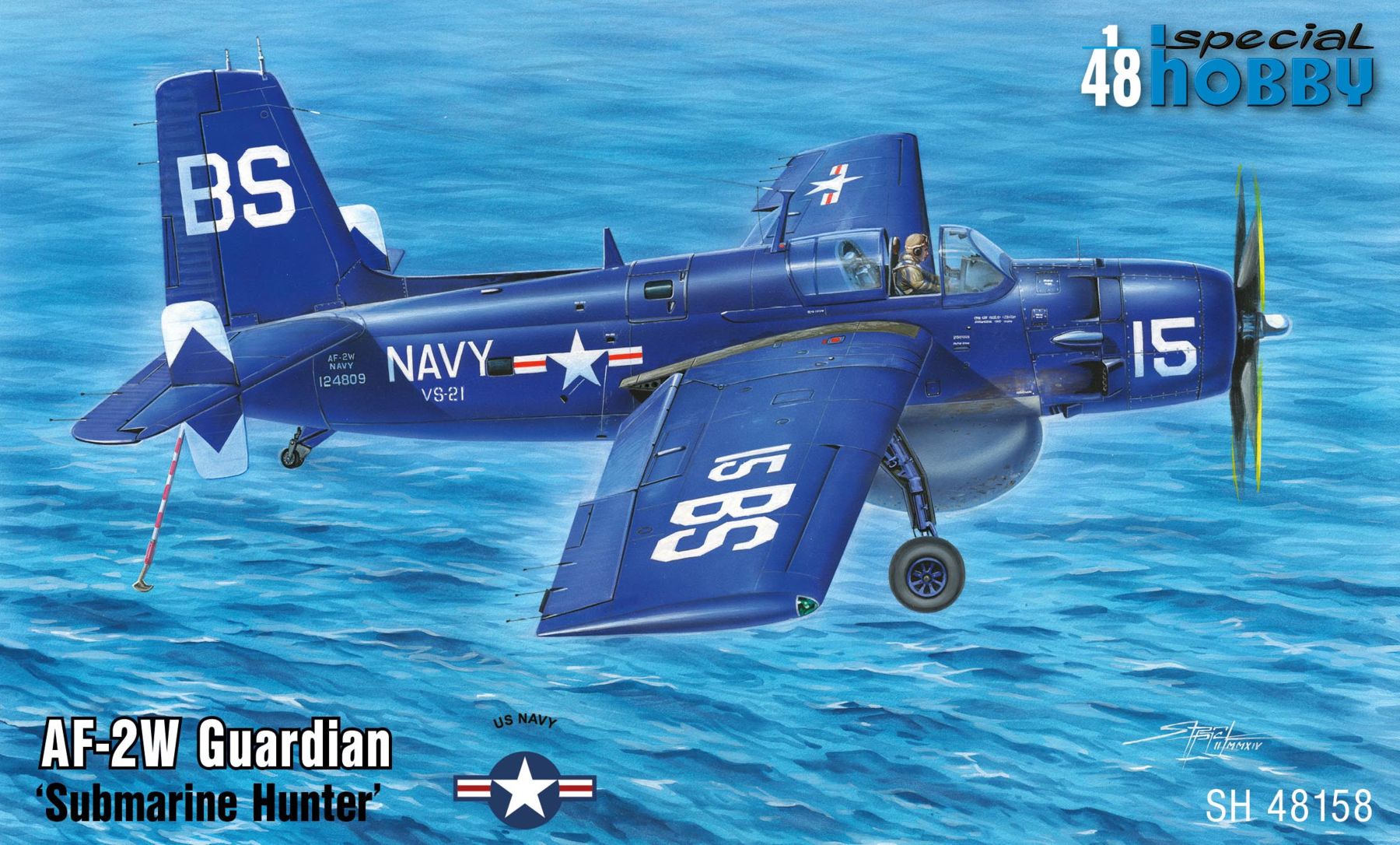
In the 1950s, a pair of AF-2 Guardian anti-submarine aircraft operated from aircraft carriers of the US Navy. While the AF-2W carried a bulky APS-20 search radar under the fuselage, the second version, the AF-2S, carried anti-submarine attack weapons (anti-submarine torpedoes, depth charges or missiles, and attack radar) in the bomb bay and under the wing. The development of the Guardian began during World War II, but the US Navy originally requested a torpedo bomber. This project was designated G-70 by Grumman and designated by the Navy as XTB3F-1. The XTB3F-1 was to have a combined propulsion system, with a P&W R-2800 radial engine in the bow driving a four-blade propeller, and a Westinghouse 19XB turbojet engine in the tail section. The turbojet engine was removed before its first flight. This happened on 19 December 1945. However, on 24 December 1945, the US Navy changed its requirements and demanded a conversion to an anti-submarine aircraft in the two above-mentioned versions. The prototype of the “Hunter”, as the AF-2W version was called, flew for the first time in November 1948, the prototype of the “Killer” in January of the following year. In 1950, the first AF-2s of both versions were included in the US NAVY's inventory. Later, they were joined by the AF-3S version. This corresponded to the AF-2S version, but carried an additional magnetic anomaly detector. AF-2s operated from both aircraft carriers and land bases. During the Korean War, they provided protection for US Navy aircraft carriers in combat areas. They were withdrawn from the front line in 1955, but served in reserve units until 1957. The Guardians became the first specialized anti-submarine aircraft of the US Navy operating from aircraft carriers. They also hold the record for the largest single-engine piston aircraft in regular service ever to operate from the decks of US Navy ships.
The kit consists of eight sprues of grey plastic parts, a sprue with clear parts, a set of resin cast parts and a fret of etches. The decals offer two all-blue machines with white trim and markings. One operated from the aircraft carrier USS Bairoko, the other from the deck of USS Badoeng Strait.
- the largest single-engine, piston engined aircraft to have ever served on aircraft carrier decks
- nicely detailed resin cast parts and photo etches already in the box