
100-SH72546 (1/72)
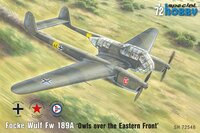
In 1937, the RLM (Reichsluftfahrtministerium) issued specifications for a new Luftwaffe reconnaissance aircraft. The companies Blohm Voss with their asymmetric BV 141, Arado with the single-engine Ar 198 and Focke Wulf with the Fw 189 project participated in the competition. The winner was the Focke Wulf.
Like the BV 141, the Fw 189 stood out with an unusual technical solution. Chief designer Kurt Tank designed the aircraft with a central fuselage nacelle and two tailplane booms from the engine nacelles. This provided the crew of three with excellent visibility. The prototype flew for the first time in July 1938 and the pre-series Fw 189 A-0s were delivered in September 1940. Production continued with the first series version of the Fw 189A-1. It was produced at the Focke Wulf factory in Bremen, where production was soon halted due to the production of the Fw 190. From March 1941, the Prague Aero factory supplied the Fw 189 (production ceased in 1943). Other Fw 189s were produced until 1944 in French factories in Bordeaux-Mérignac. In the second half of 1941, the A-1 version was replaced on the production lines by the A-2 version with more powerful armament. A small series of training and liaison versions B was also built, differing in the shape of the fuselage nacelle and other details. A ground attack version, designated Fw 189C, was tested in prototypes; the first prototype Fw 189V1 crashed, and even the modified prototype Fw 189V-6 did not convince.
The vast majority of Fw 189 aircraft served on the Eastern Front. The Focke-Wulf Fw 189 A proved to be capable of handling from unpaved airfields, with excellent maneuverability and reliability. Several Fw-189A-1s were even fitted with the FuG-212 Lichtenstein C-1 radar and an oblique cannon and used as night fighters in Romania in 1944. The Fw 189 also saw service with the Slovak, Hungarian and Romanian air forces.
Kit Fw 189A-1 SH72546 includes three plastic parts sprues, a clear parts sprue and 3D printed parts. The decals feature two German aircraft, one captured Soviet aircraft and one Norwegian aircraft. This originally German aircraft from the Eastern Front flew to Norway just before the end of the war and was used by the Norwegian air force after the war.
- model kit of an unusually looking machine
- interesting colour schemes
Nationality: german
Producer: Special Hobby
Like the BV 141, the Fw 189 stood out with an unusual technical solution. Chief designer Kurt Tank designed the aircraft with a central fuselage nacelle and two tailplane booms from the engine nacelles. This provided the crew of three with excellent visibility. The prototype flew for the first time in July 1938 and the pre-series Fw 189 A-0s were delivered in September 1940. Production continued with the first series version of the Fw 189A-1. It was produced at the Focke Wulf factory in Bremen, where production was soon halted due to the production of the Fw 190. From March 1941, the Prague Aero factory supplied the Fw 189 (production ceased in 1943). Other Fw 189s were produced until 1944 in French factories in Bordeaux-Mérignac. In the second half of 1941, the A-1 version was replaced on the production lines by the A-2 version with more powerful armament. A small series of training and liaison versions B was also built, differing in the shape of the fuselage nacelle and other details. A ground attack version, designated Fw 189C, was tested in prototypes; the first prototype Fw 189V1 crashed, and even the modified prototype Fw 189V-6 did not convince.
The vast majority of Fw 189 aircraft served on the Eastern Front. The Focke-Wulf Fw 189 A proved to be capable of handling from unpaved airfields, with excellent maneuverability and reliability. Several Fw-189A-1s were even fitted with the FuG-212 Lichtenstein C-1 radar and an oblique cannon and used as night fighters in Romania in 1944. The Fw 189 also saw service with the Slovak, Hungarian and Romanian air forces.
Kit Fw 189A-1 SH72546 includes three plastic parts sprues, a clear parts sprue and 3D printed parts. The decals feature two German aircraft, one captured Soviet aircraft and one Norwegian aircraft. This originally German aircraft from the Eastern Front flew to Norway just before the end of the war and was used by the Norwegian air force after the war.
- model kit of an unusually looking machine
- interesting colour schemes
Nationality: german
Producer: Special Hobby
|
22.50 EUR
|
|
| Add to cart |